Exhaust
Exhaust Manifold Leak Symptoms: How to Confirm the Fault
Published:
Edited and fact-checked by: Jacob Bowen
General information; vehicle-specific diagnosis requires an inspection. How we prepare our guides · This page reserves space for ads. Advertising policy · Privacy choices
The quick answer
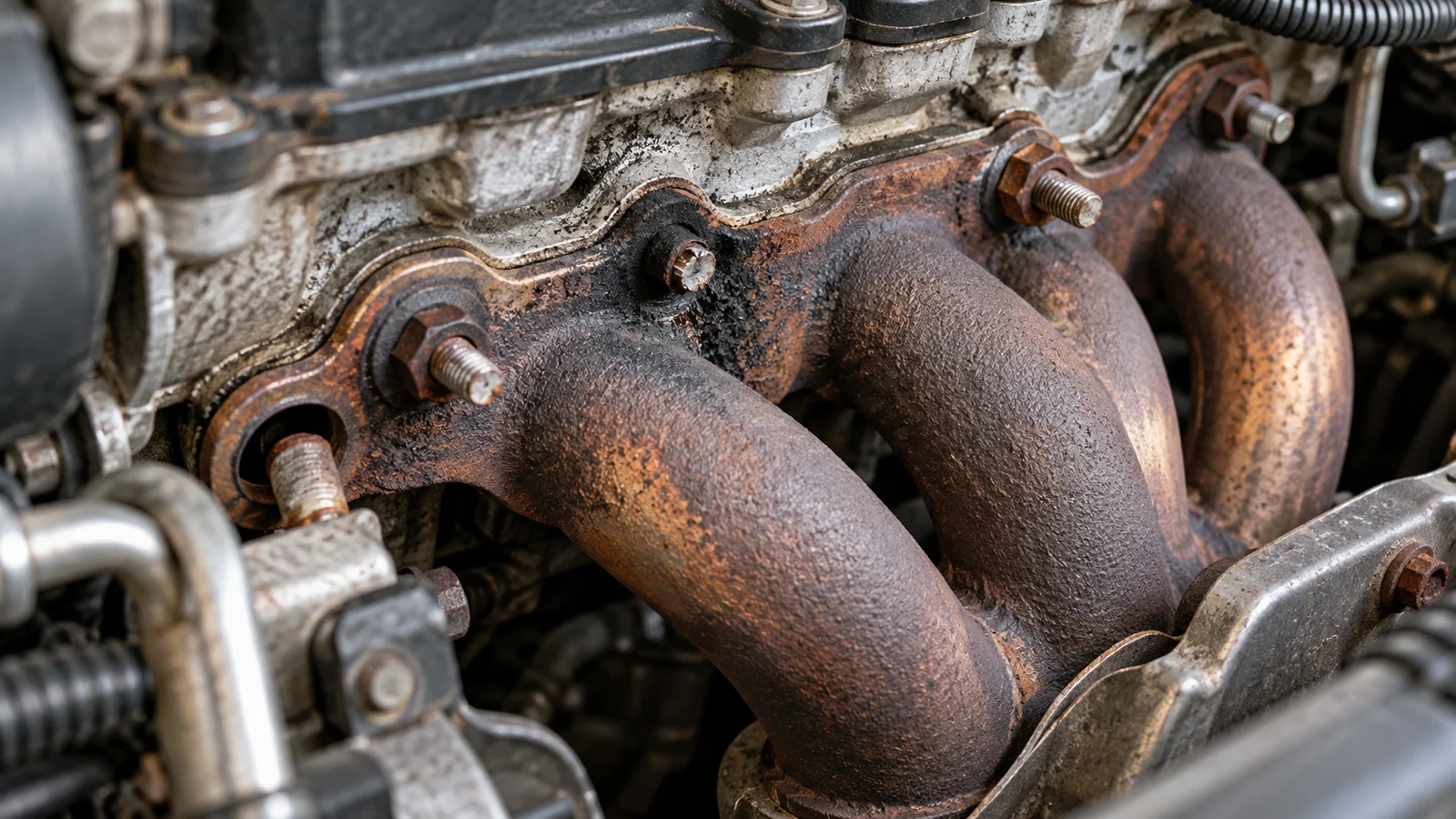
An exhaust-manifold leak can cause ticking, exhaust odor and soot marks near the leaking joint or crack. Those signs need inspection: a tick alone does not prove a cracked manifold or broken bolt. A technician should locate the escape point, inspect the gasket and fasteners, and distinguish manifold leakage from other engine noises or downstream exhaust leaks.
Is the leak at the manifold, gasket or another exhaust joint?
The manifold, its sealing joint and the connected exhaust pipe are separate possible leak locations. Fel-Pro lists distinct manifold, pipe-flange and other exhaust gaskets because they seal different joints. A quote for one location may not address another.
Record whether the noise is strongest at cold start, after warming or under load. Walker recommends checking an exhaust system cold and again at normal operating temperature. A change as it warms is useful evidence, but not a diagnosis by itself.
How does a shop confirm an exhaust-manifold leak?
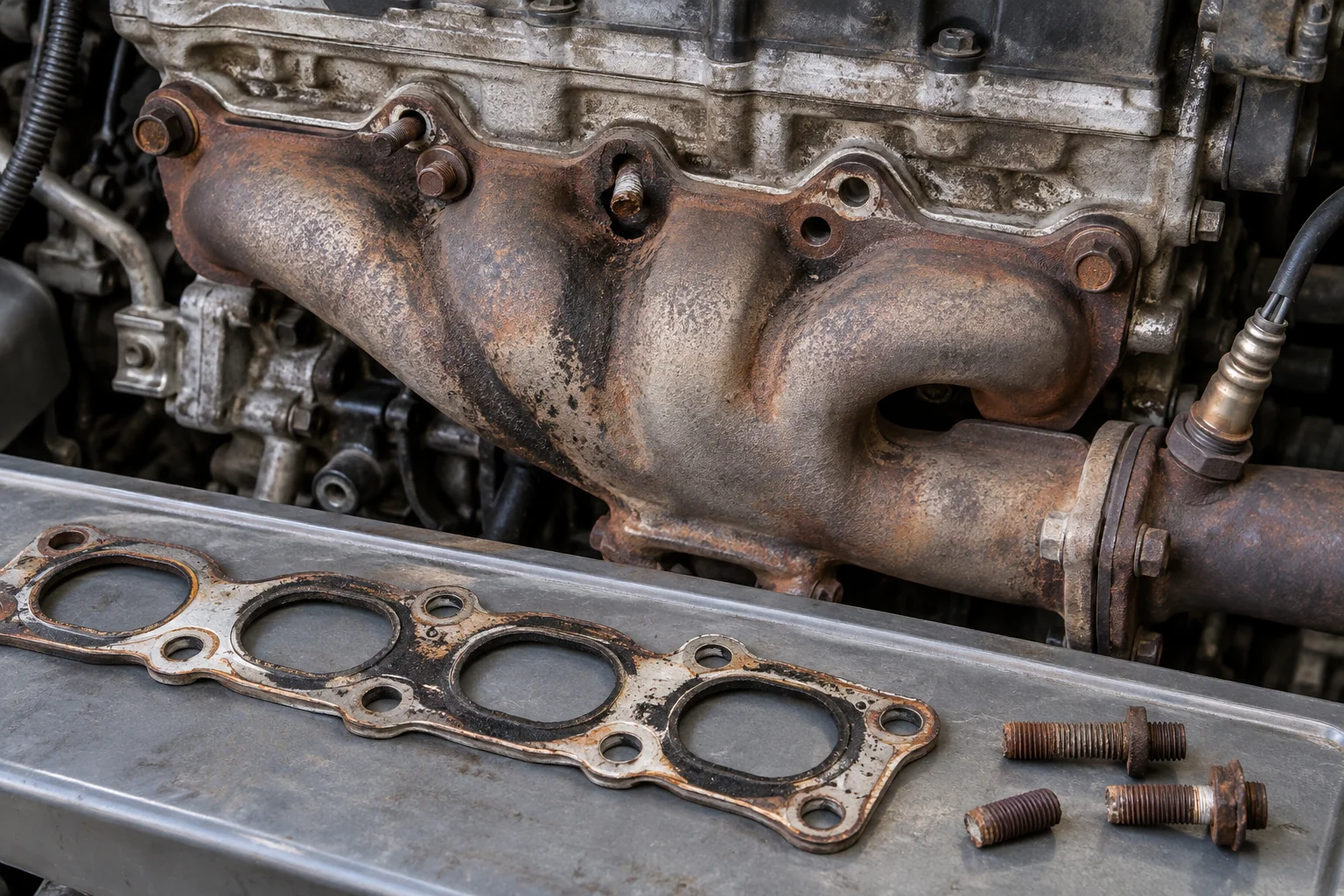
Inspect for soot tracks, damaged fasteners, visible cracks and heat effects around the suspected area. Where a small leak is hard to locate, suitable smoke-testing equipment can help identify the escape point.
Check nearby connections too. Walker cautions that even small exhaust leaks can affect oxygen or air/fuel-sensor information. A sensor-related complaint should therefore include leak inspection before assuming the sensor needs replacement.
Do not reach around a hot or running manifold to feel for escaping gas. Tell the technician about the original noise rather than trying to prove the leak by hand, blocking the tailpipe or loosening fasteners.
Does a broken manifold bolt mean you need a new manifold?
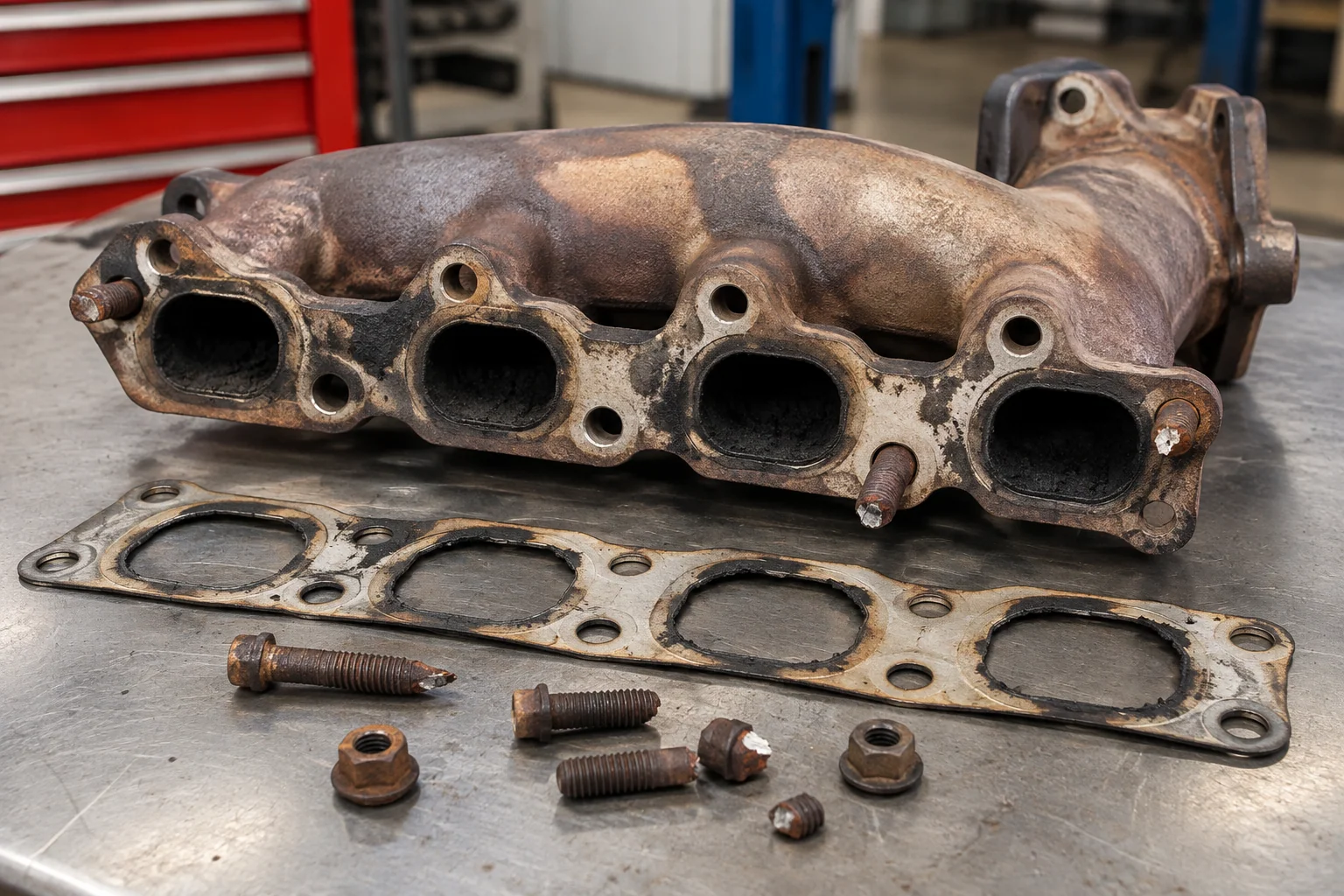
Not automatically. The shop needs to assess the fastener, sealing surfaces, gasket and manifold condition. Broken hardware may require additional access and extraction work, while a cracked or unusable manifold calls for a different parts scope.
That inspection matters on a 5.3-liter GM engine, a 5.7 Hemi, a 5.4 Triton or an Audi just as it does on another engine. Engine names in a search result do not establish the same failure or repair for every model year.
What should the repair include?
Correct the confirmed leak using the applicable parts and service procedure. Walker notes that uneven or incorrect flange tightening can cause leaks and damage. Use the exact manufacturer's sequence and torque, rather than its illustrative torque example as a specification for your engine.
Recheck for leakage and the original complaint afterward. If engine-control readings were affected, verify them too. The related manifold-repair guide covers the installation decisions in more detail.
If exhaust fumes enter the passenger compartment, stop safely and arrange inspection rather than continuing to drive with the windows open. Exhaust sealing is a safety issue as well as a noise concern.
How should you compare manifold-leak repair quotes?
RepairPal's broad US manifold-replacement estimate, updated September 3, 2026, is $1,514–$1,724: labor of $349–$512 and parts of $1,164–$1,212. It excludes taxes, fees, location and related work.
That is a replacement benchmark, not a price for every gasket leak or broken bolt. Ask which joint is leaking, whether the manifold is reusable, and whether the quote includes extraction, gaskets, hardware and verification. Compare the same confirmed repair scope.
Sources & further reading
- Walker Exhaust — Exhaust Leak Symptoms & Repair
- Walker Exhaust — Correct Exhaust Flange Bolt Torque Pattern
- Fel-Pro — Exhaust Flange & Exhaust System Gaskets
- RepairPal — Exhaust Manifold Replacement Cost Estimate
Vehicle designs and maintenance requirements vary. Consult the owner’s manual for your exact vehicle and seek a qualified inspection for a specific fault.